
Hello, Beauty Buns! I’m diving into sunscreen today. Sunscreen has recently become a hot topic in the cosmetics world. What is all the hype about? Is sunscreen really that important? What does broad-spectrum mean? How does it all work? Let’s dive in!
Sunscreen and Cancer
Cancer is a scary word. What if I told you that you have a 20% chance of developing cancer by the age of 70? Even if it is just a 20% chance, I would be concerned. What if there was a product that would lower your risk by 40-50%? That sounds like a miracle product, right? Well, that miracle product is sunscreen.
According to the Skin Cancer Foundation, 1 in 5 Americans will develop skin cancer by the age of 70, more than 2 people die of skin cancer in the US every hour, and having 5 or more sunburns doubles your risk for melanoma. (Skin Cancer Foundation) However, I don’t see people being that concerned about skin cancer because when it is caught early, the survival rate is 99%. Remember, even with a high survival rate, cancer is still cancer.
Skin cancer develops from exposure to UV radiation from the sun. UV radiation damages your cells, cell damage can lead to cell mutation, and cell mutation leads to cancer.
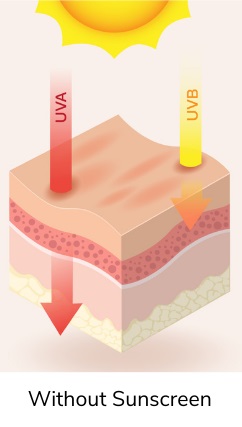
There are two types of UV radiation: UVA and UVB. UVA and UVB rays damage the skin in different ways. UVA rays damage the deep layers of your skin, your cell structure, and your skin’s collagen. UVB rays only damage the top layer of your skin. You can blame UVB rays for those painful sunburns.
Montréal Science Centre has a good acronym for remembering the difference, “A is for Age. B is for burn.” If you want to protect yourself from skin cancer, you need a sunscreen that protects from UVA and UVB radiation.
Image from Montréal Science Centre
When choosing a sunscreen in the US, you must look for two keywords: broad-spectrum and SPF. A broad-spectrum sunscreen will protect you from both UVA and UVB rays. The SPF, or sun protection factor, rating tells you how well the product will protect you from getting sunburned. (Remember: B is for burn. The SPF rating only refers to protection from UVB rays, not UVA.) The FDA requires any product that is labeled sunscreen to have an SPF rating of at least 15. At the moment, the highest SPF rating is SPF 50. However, not everyone needs SPF 50 based on where they live or the time of day. For example, the sun’s rays are more powerful at noon than at night. The sun’s rays are also more powerful at the equator than at the North Pole. (FDA)
The last thing to keep in mind when choosing a sunscreen is its water resistance. Water-resistant sunscreen is not important if you stay inside most of the time and don’t sweat much. (Yes. You do need to wear sunscreen even if you are indoors all day. Windows only block UVB rays, not UVA rays.) You must wear water-resistant sunscreen if you are outside, sweating, or going into water. Always read your labels and reapply your sunscreen as directed for the best protection.
Examples of Sunscreens


Types of Sunscreen
There are two categories of sunscreens: mineral/physical and chemical/organic. All sunscreen products fall into one of these two categories based on their active ingredients, also known as UV filters.
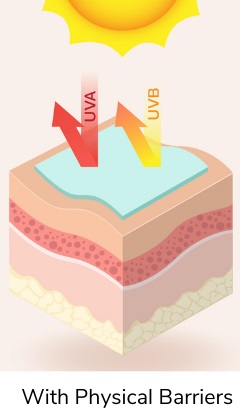
Mineral sunscreen products will use zinc oxide or titanium dioxide as their UV filters. These UV filters act as a protective layer on top of the skin. UV rays reflect off these filters. (The Ilia Skin Tint is a mineral sunscreen.)
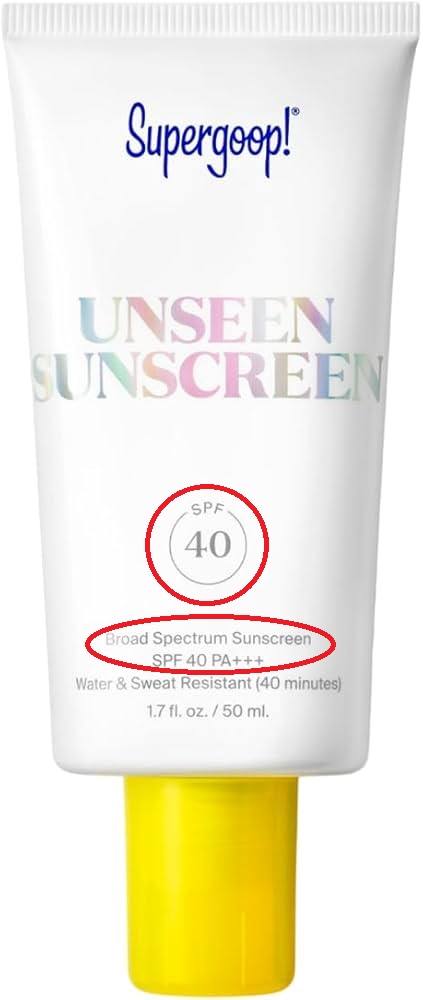
There are twelve chemical UV filters. The most common are oxybenzone, avobenzone, octinoxate, octisalate, octocrylene, and homosalate. Chemical sunscreen products will normally have more than one chemical filter, but not all twelve. (The Unseen Sunscreen from Supergoop! uses three chemical filters.) Chemical sunscreens sink into the top layers of the skin and absorb UV rays instead of reflecting them.
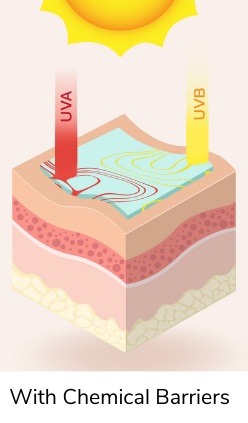
Images from Montréal Science Centre
As of the publishing date of this article, the FDA has only approved the use of two of the 16 possible UV filters and banned two of the 16 filters. The other twelve chemical filters are classified as “need more testing.” I will be sharing another article about those filters and the controversy between the cruelty-free community and the FDA.
Which Type of Sunscreen is better?
My next sunscreen article will provide more information about each UV filter to help you decide what is best for you. I still have to do more research before making my final decisions. Surprise, surprise! Sunscreen is a lot more complicated than you think. By the way, did you know sunscreen is categorized as a drug by the FDA? I will talk about that in the following article.
Sunscreen from Other Countries

You may have noticed that the Unseen Sunscreen is a Broad Spectrum Sunscreen SPF 40 PA+++. Asian countries use a PA rating to determine how well a sunscreen protects you from UVA rays. (Remember: SPF equals UVB protection. PA equals UVA protection.) When reading a PA reading, look at how many plus symbols come after. The more symbols a product has, the stronger the product. Today, PA++++ is the highest rating you can find in international sunscreen products. (I heard about a PA+++++ once, but I have never seen it.)
Final Thoughts
A creator I follow on YouTube says that sunscreen is like “an anti-cancer drug.” After doing my research, I can’t entirely agree with that statement. Sunscreen is not an “anti-cancer drug.” Sunscreen is a cancer-prevention drug. You could be the most diligent sunscreen user in the world, and you may still get skin cancer one day. Life happens, and nature does what nature does. However, using sunscreen diligently dramatically reduces your risk of skin cancer. If I can reduce my chances of getting cancer by applying a product to my skin, that seems like a pretty good plan to me.
Thank you guys so much for reading! If you have any more sunscreen questions, let me know! I can’t wait to get my second article out. I had a fun rabbit-hole dive with this topic.
 Brianna Rae